

Planning
What a Smart Gym Needs From the Building
Floor, Route, Headroom, Power, Network and Clear Space — Before It Is Ordered
A smart strength machine can stand in for a bench, a cable station and an orientation. It also asks questions a weight stack never did, and most of them are answered by the building rather than by the equipment.
Floor: the weight decides the conversation
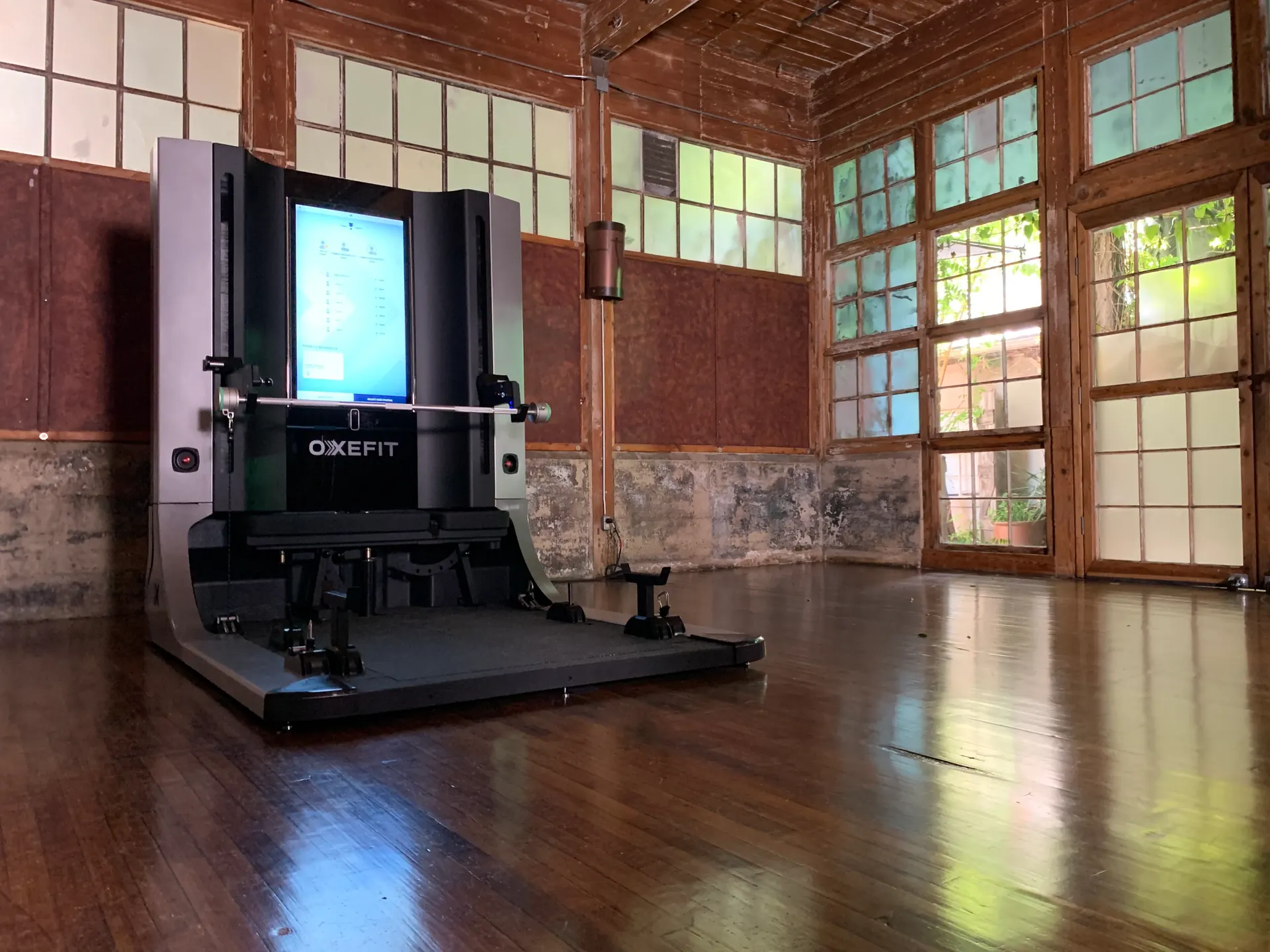
Two machines with the same purpose can be very different loads. OxeFit publishes 2,450 pounds for its XP1 on a footprint of 7 feet 8 inches by 5 feet 10 inches. Over those 44.7 square feet it averages about 55 pounds per square foot before a user, and the load bears at the machine’s feet rather than evenly. Its XS1 is a fraction of that: OxeFit’s brochure lists 300 pounds and its site 350, which over a 45 by 82 inch footprint is 12 to 14 pounds per square foot.
IBC Table 1607.1 designs gymnasium and fitness areas for a 100 psf live load, ordinary residential floor areas for 40 psf and sleeping areas for 30. The XS1 rarely starts a structural conversation by itself. The XP1 should, anywhere but a slab on grade. The engineer of record needs the operating weight, the footprint and where the feet land, for that machine in that room; the rest of the question is in can your floor take a gym.
Route: it has to get there
OxeFit lists the XS1 at 53 by 29 by 86 inches as shipped, so the test is every door, turn and elevator cab between the dock and the room, not the machine’s finished size. The XP1 goes in through OxeFit’s own installation service, and at 2,450 pounds the elevator’s rated capacity and the floors along the way belong in the survey as much as the door widths do. Both questions are cheap before a door frame is hung and expensive afterward.
Headroom: measure the person, not the machine
The XS1 stands 81 inches tall and the XP1 7 feet 2 inches, and both fit under an ordinary ceiling. The person on the deck is the taller thing in the room: a tall user standing on it with a bar overhead reaches past the top of either frame. Measure to the lowest thing above the deck, which is usually a sprinkler head, a soffit, a light or a fan rather than the ceiling itself.
Power: one outlet, in the right place
OxeFit asks for 110 V, 20 A for the XS1 and a 110 V outlet for the XP1. Neither is hard to provide; both are easy to provide in the wrong place. The outlet belongs behind the machine, so no cord crosses a walkway, and on a circuit the cardio bank has not already used, because commercial treadmill manufacturers specify a dedicated 120-volt, 20-amp branch circuit for each unit. In an existing room, read the panel schedule before choosing the wall.
Network: the requirement nobody draws
A smart gym that cannot get online loses its classes and its updates, and with some memberships its users’ history. The usual cause is an amenity Wi-Fi network with a sign-in page, which a person can click through and a machine cannot. Ask for a network the machine can join once and stay on, with a signal at the machine strong enough to stream video.
Then decide whose account it is. A membership registered to one manager’s email address outlives that manager, and the property discovers it at renewal. Use a shared property address, write the renewal date into the operating budget, and settle whether the room runs on an open-use membership or one that keeps a profile for each person.
Clear space: plan to the reach, not the footprint
OxeFit lists a 6 by 8.5 foot set-up space for the XS1, about 51 square feet around a machine that covers 26. The deck folds up to 24 inches deep, which helps when the floor is needed for something else, but draw the room with it down, because that is how it is used, and rowing, paddling and cable work reach past it. The XP1 does not fold, and OxeFit describes cable work up to 15 feet off its platform, so the open floor around it is part of the machine.
The accessibility rules treat it like any other machine. Under the 2010 ADA Standards at least one of each type of exercise machine needs a 30 by 48 inch clear floor space on an accessible route at least 36 inches wide, and that space is permitted to overlap the route. In a small amenity room, draw it first.
Placement: where it can be seen
In a room nobody staffs, put it in the sightline from the door. That is safer, and it is the piece a tour will stop at. Keep the screen from facing a window, since a touchscreen is hard to read against glass in daylight, and think about whose wall it stands on, because classes have sound. Both machines are indoor equipment and belong in a conditioned room rather than on a covered patio.
License: buy the commercial one
A consumer machine and a commercial one can look identical, and they are not the same purchase. OxeFit states that a consumer unit put to commercial use loses its membership license and its warranty. What differs is what the license and the warranty cover: a shared room rather than one household. Ask for the commercial version by name, with the membership, its term and its renewal date on their own line of the quote.
Settle these before the order
- Floor. Operating weight, footprint and where the feet land, to the engineer of record for anything above grade.
- Route. Size as shipped against doors, turns and the elevator’s cab and rating.
- Headroom. The lowest obstruction above the deck, against a tall person pressing overhead.
- Power. An outlet behind the machine, on a circuit with room on it.
- Network. A signal at the machine, no sign-in page, and a shared address on the account.
- Clear space. The set-up space with the deck down, the ADA clear floor and the route, on one drawing.
- License. The commercial version, with its membership term and renewal date.
We settle all seven on the layout before we quote a machine. See the OxeFit XS1 and XP1 side by side, the other smart and interactive equipment we supply, and how the drawing is made.
Published November 23, 2026 · 6 minutes read
More on multifamily amenity fitness centers

The Fitness Amenity Decisions a Developer Makes, and When
Structure at design development, power and clearances in the CDs, the Texas accessibility review at permit. What each project stage decides about the fitness room. Read the post.

Remodeling an Apartment Fitness Center
A remodel inherits the structure, the panel and the slab. What that constrains, how to phase the work so residents keep a room, and where the old equipment goes. Read the post.

Replacing One Piece of Equipment in an Amenity Gym
A single machine is the most common amenity purchase and the easiest to get wrong. What decides repair versus replace, and what the new unit has to match. Read the post.
In short
A smart gym asks the building for six things: a floor that can carry it, a route in, headroom, power, a network it can join, and clear space beyond its footprint. The two OxeFit machines show the range. The XS1 is a few hundred pounds on about 26 square feet; the XP1 is 2,450 pounds on about 45, roughly 55 pounds per square foot before anyone steps on it.
Part of what we do on multifamily amenity fitness centers.
Common questions
How much does a smart gym weigh?
It varies by a factor of seven or more. OxeFit publishes 2,450 pounds for its XP1, and lists its XS1 at 300 pounds in the brochure and 350 on its site. Use the operating weight of the exact model and package, add a user, and divide by the footprint it bears on; that is the figure an engineer will want.
Can a smart gym go on an upper floor?
A light, folding machine usually can: an XS1 averages 12 to 14 pounds per square foot before a user, against the 40 psf IBC Table 1607.1 uses for ordinary residential floors. An XP1 averages about 55 and bears at its feet, so anywhere but a slab on grade it goes to the engineer of record before it is ordered.
How much space should we plan for a smart gym?
Plan to the set-up space rather than the footprint. OxeFit lists 6 by 8.5 feet for the XS1 with its deck down; the XP1 is 7 feet 8 inches by 5 feet 10 inches, and its cable work reaches up to 15 feet off the platform. Add the ADA clear floor space, 30 by 48 inches on an accessible route, and it can overlap the aisle.
What power and internet does a smart gym need?
OxeFit asks for 110 V, 20 A for the XS1 and a 110 V outlet for the XP1, placed behind the machine. Both want a steady network connection that does not sit behind a sign-in page, strong enough at the machine to stream video. Check the panel schedule first, because treadmills have often taken the circuits.
Can we put a consumer smart gym in an apartment or office gym?
No. OxeFit states that a consumer machine in commercial use loses its membership license and its warranty. Order the commercial version with the commercial membership, so that the machine in the room is the one its paperwork covers.
Where should a smart gym stand in an unstaffed room?
In the sightline from the door, with its outlet behind it, the screen turned away from windows, and its set-up space clear with the deck down. Keep it off a wall shared with a bedroom where you can, because classes have sound.