
Eleven Services, One Team
What Each Service Covers
Most projects use several of these together — a design becomes a procurement order, a delivery crew installs it, and a maintenance plan keeps it running. Here is what each one actually does.
Layout / Design
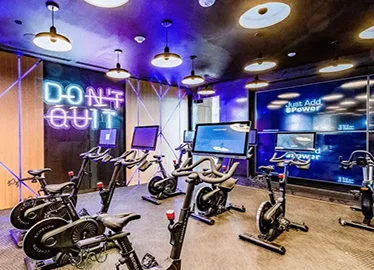
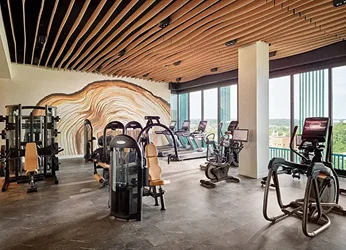
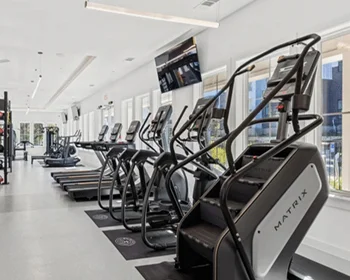
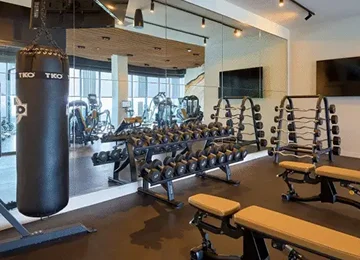
Fit Supply designs commercial fitness facilities nationwide, from a single training room to a multi-zone wellness center — curating cardio and strength, spa and recovery, and studio and locker spaces into one experience built around how the room will actually be used. Every layout arrives as a photorealistic 3D rendering and a scaled 2D floor plan before a single piece of equipment is ordered, so what gets approved is exactly what gets built.
More on layout and design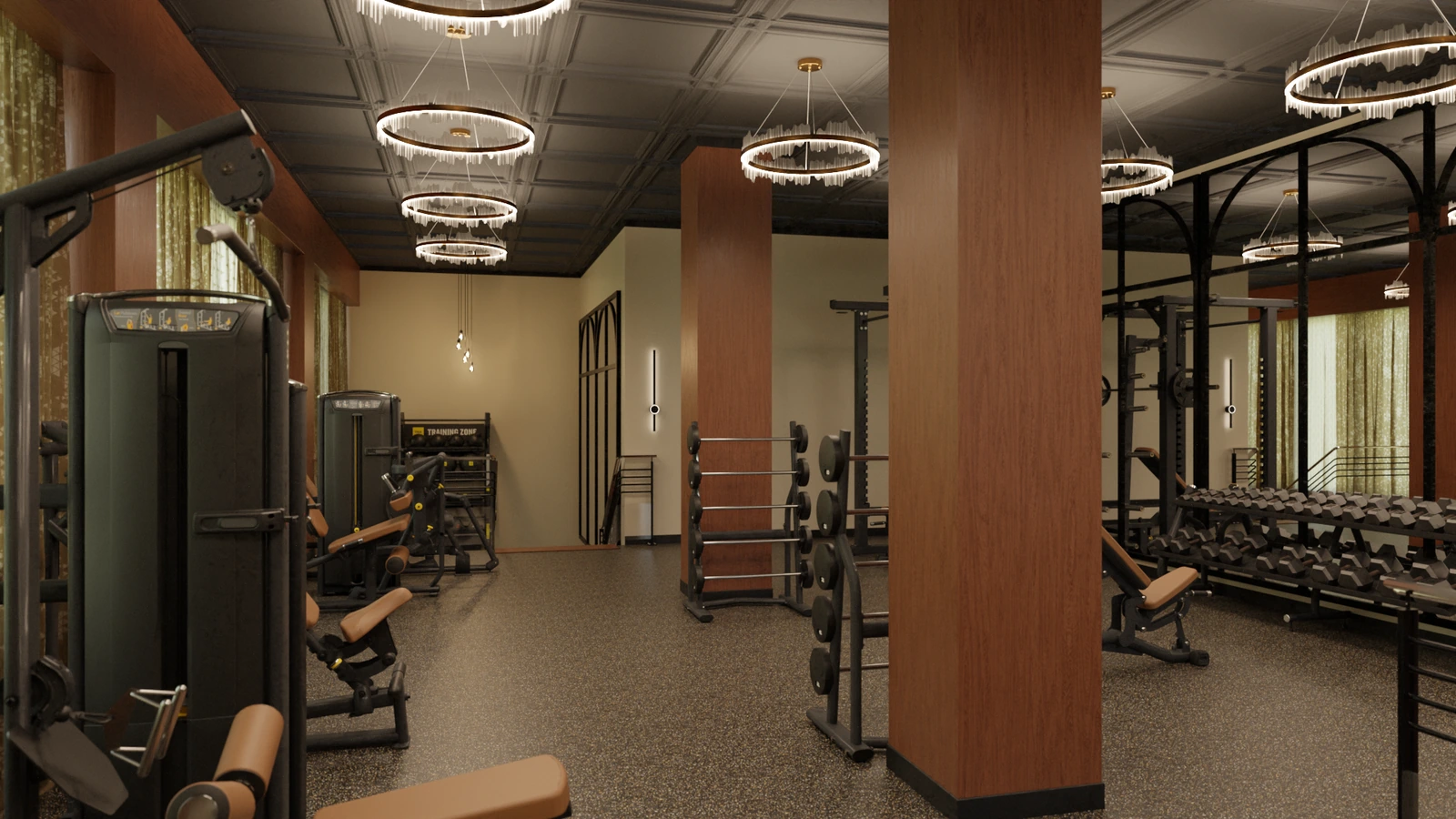
Luxury Home Gym Design
Fit Supply designs and installs luxury home gyms to the same standard as its commercial facilities: the room is measured, drawn to scale and rendered before anything is ordered, then commercial-grade equipment from 50+ manufacturers, mirrors, wall graphics, zoned flooring, sauna and cold plunge are specified to the house. 300+ Texas home installations since 2020 by our own crews; nationwide through our partner network.
More on luxury home gym design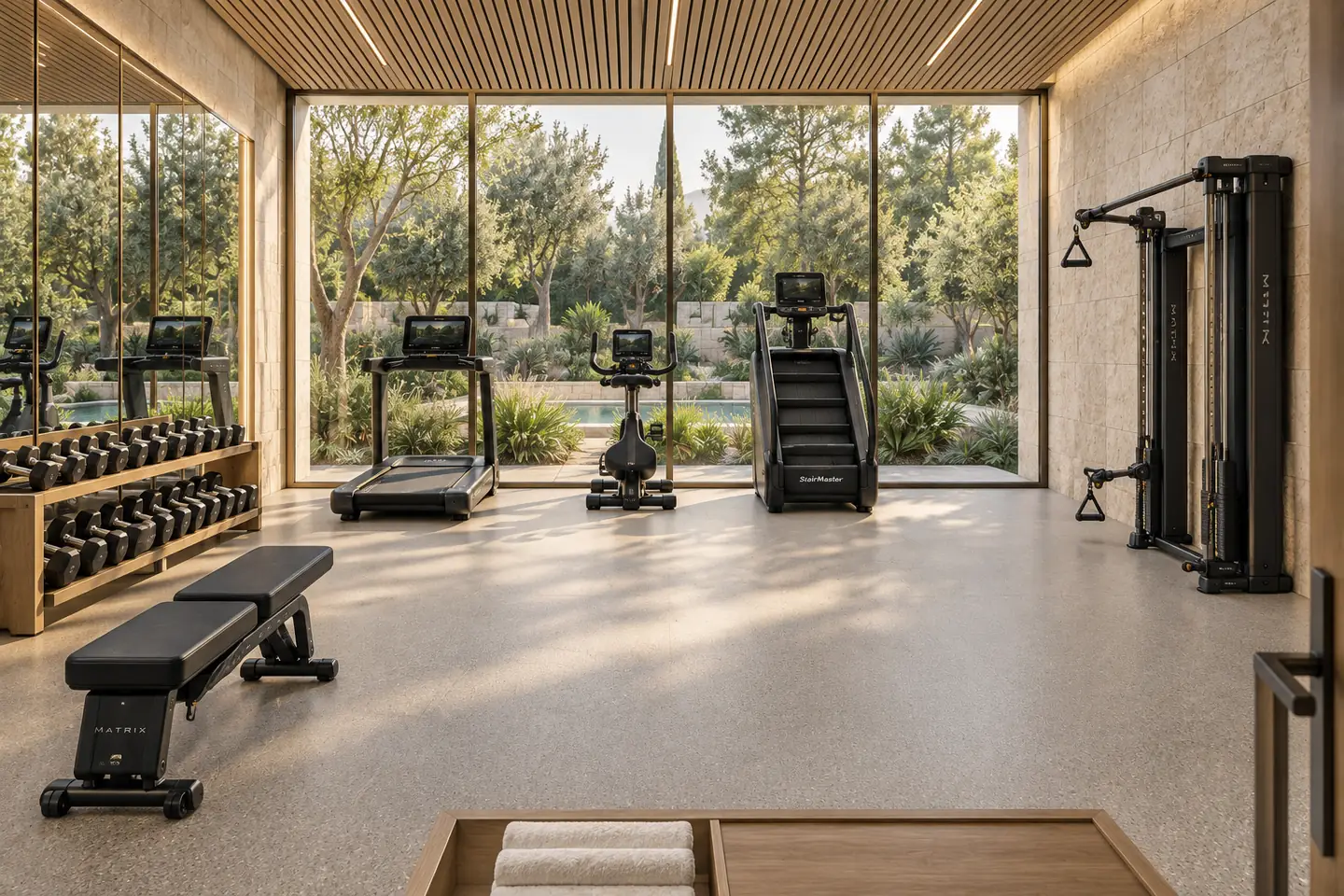
Equipment Consultation
Fit Supply's equipment consultation sizes the cardio, strength and recovery mix around who actually uses your building and when, working to the 25 to 50 square feet per station that ACSM allows rather than fitting a standard package into your room.
More on equipment consultation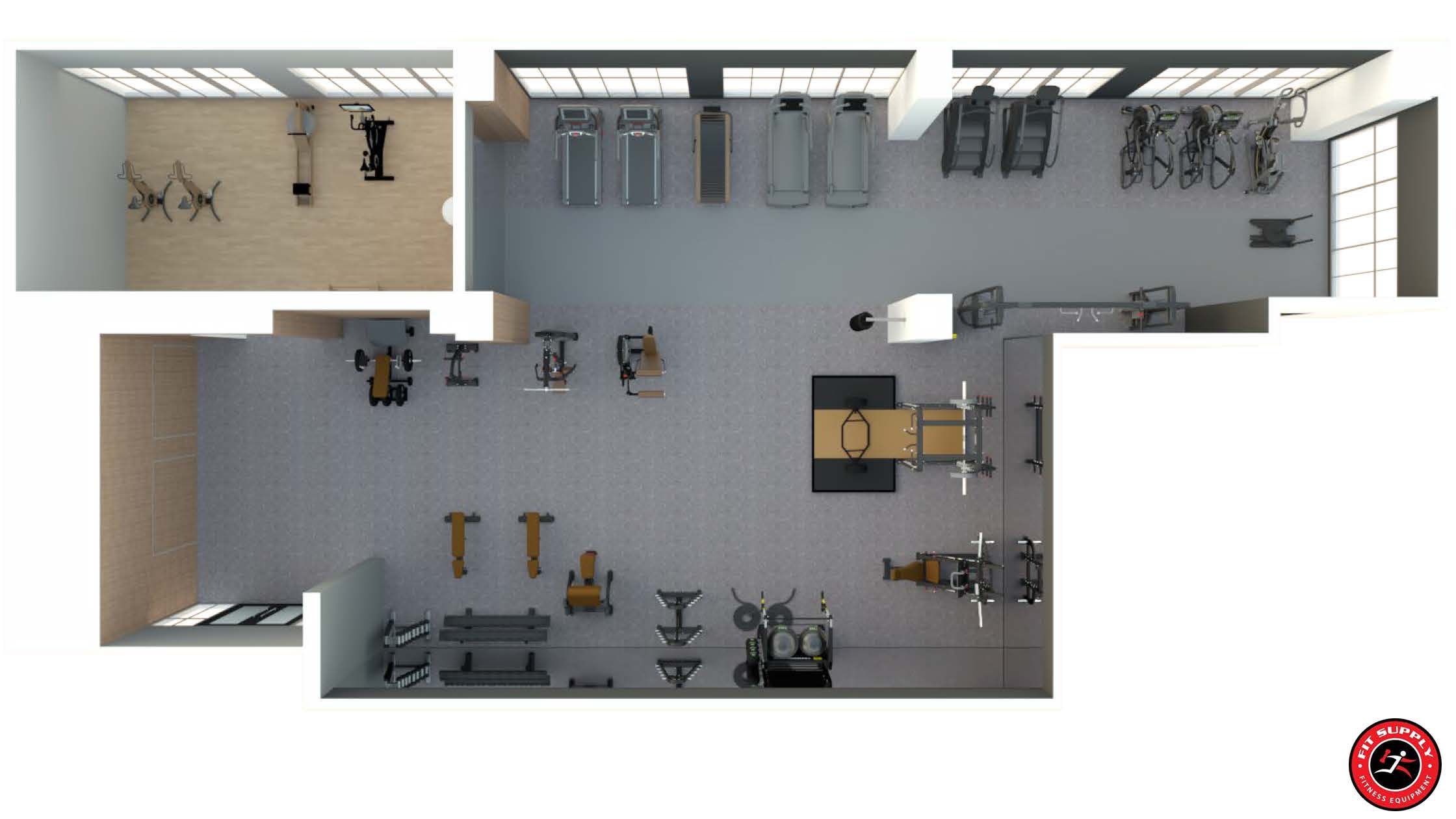
Procurement
Fit Supply manages commercial fitness equipment procurement end to end — matching the right manufacturers to a project and consolidating them into one order, then supplying everything a construction submittal package needs: cut sheets, dimensions, weights and power specifications like 120-volt, 20-amp circuits.
More on procurement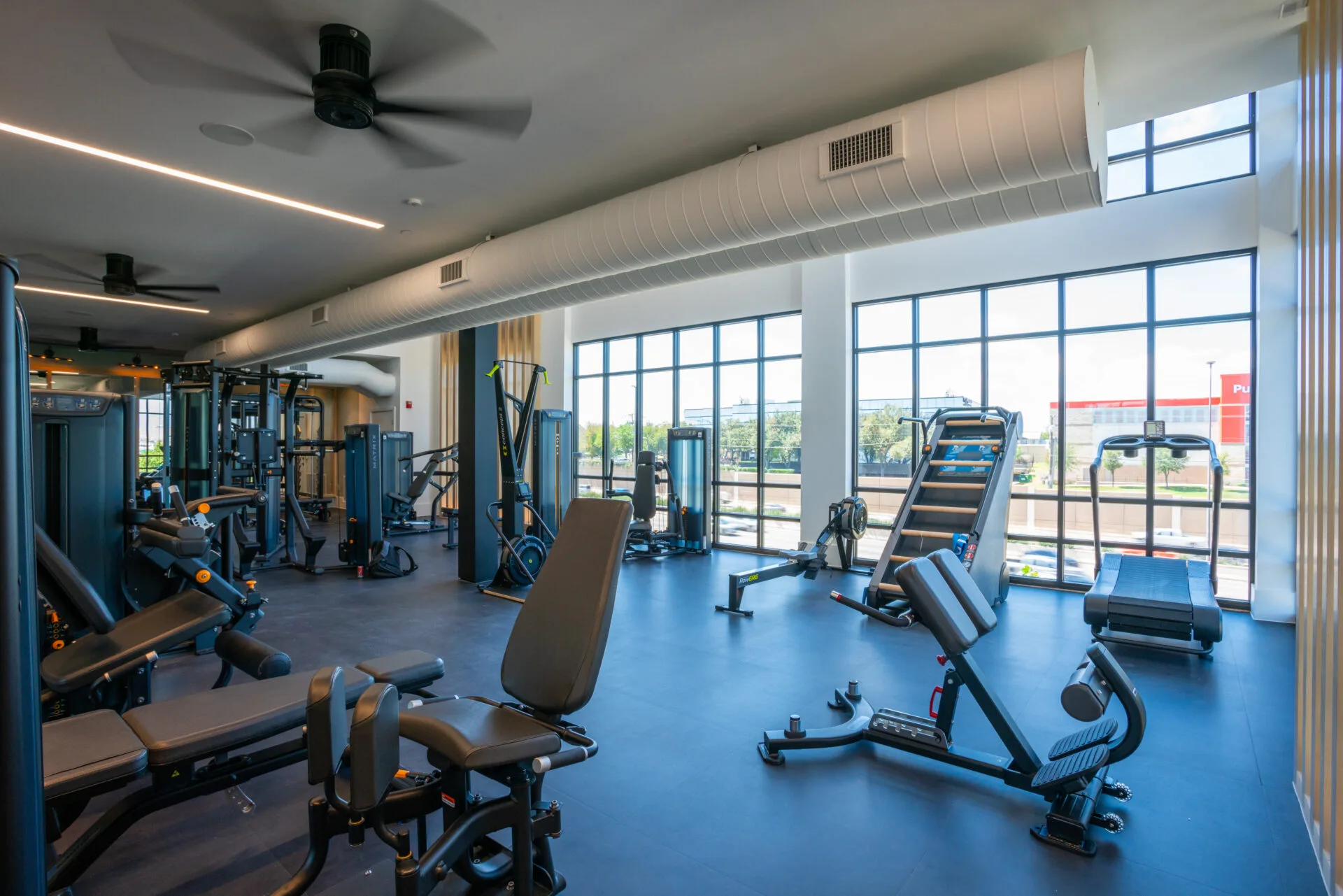
Flooring
Fit Supply supplies and installs commercial fitness flooring specified zone by zone rather than room by room — 8 mm rubber suits cardio and selectorized areas, while free-weight zones, power racks and drop zones need heavier build-ups and platforms.
More on flooring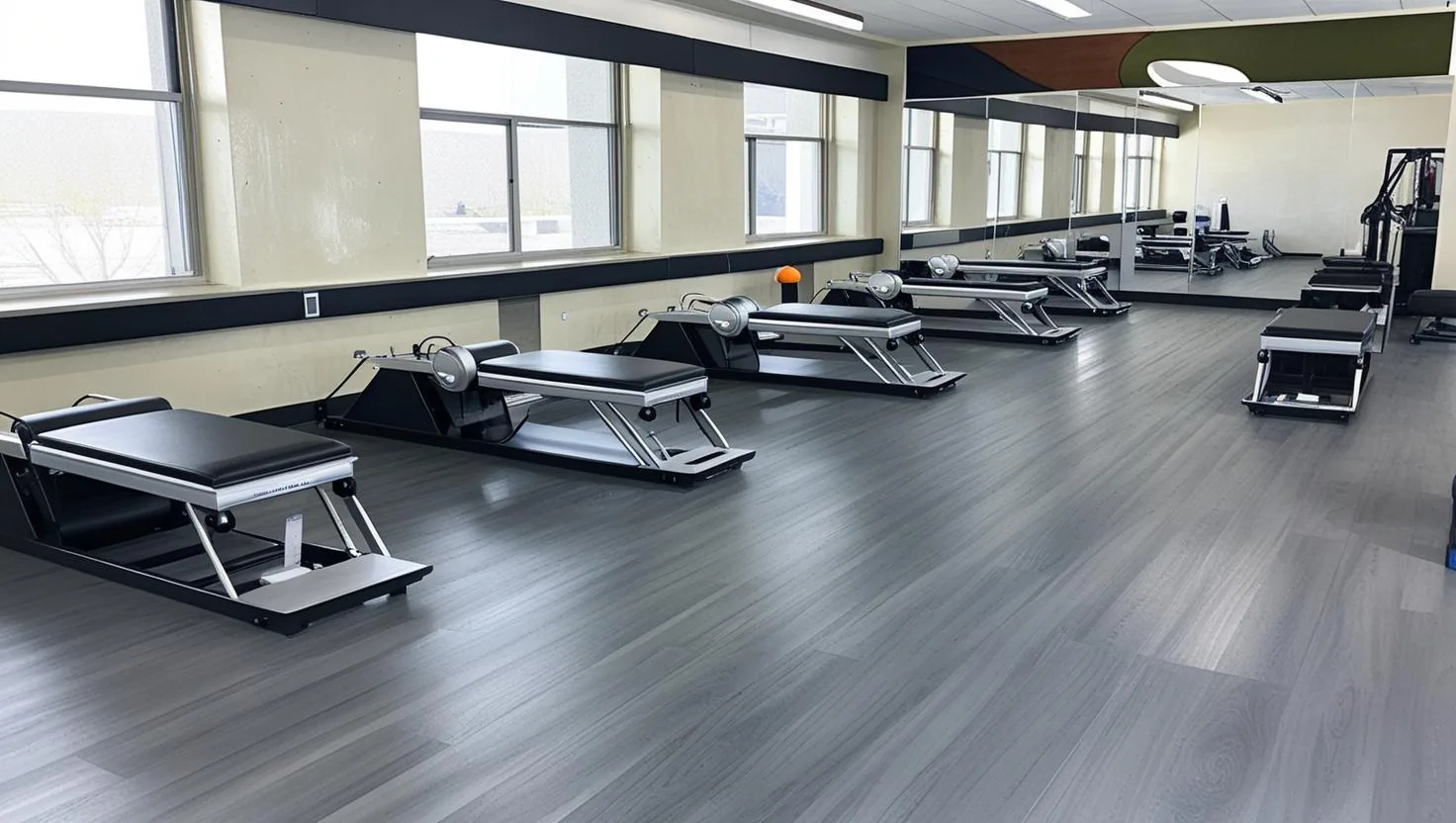
Recovery
Fit Supply designs and equips commercial recovery spaces with cold plunges, saunas and infrared pods — three core recovery modalities built for durability and daily use in gyms and wellness facilities.
More on recovery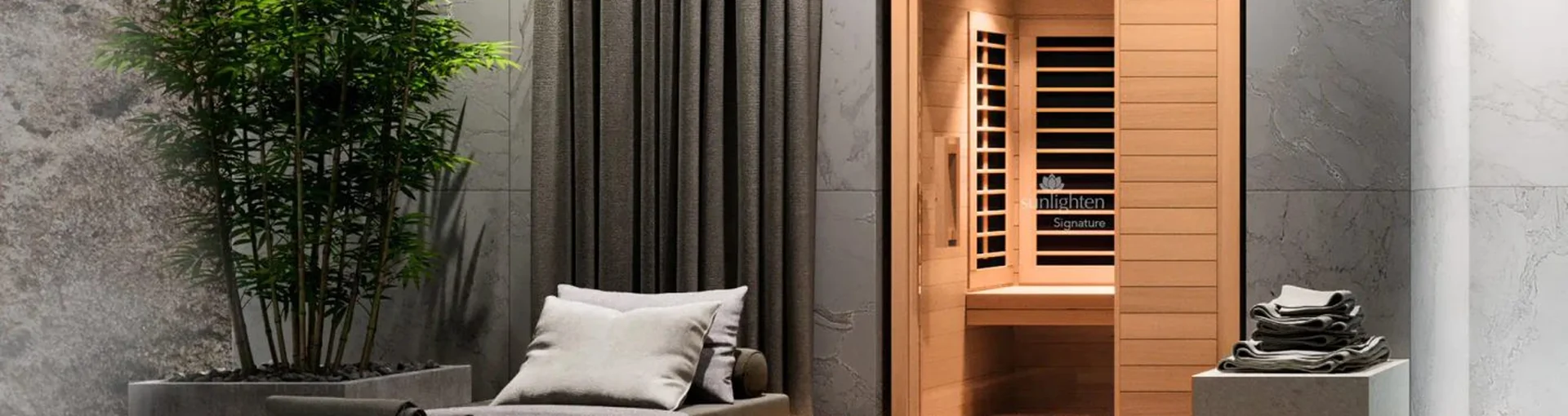
Outdoor Fitness
Fit Supply designs and equips outdoor fitness spaces — six categories of weatherized rig, functional structure, turf and lockable storage that turn rooftops, pool decks, courtyards and amenity lawns into training space that works all year, installed nationwide since 2007.
More on outdoor fitness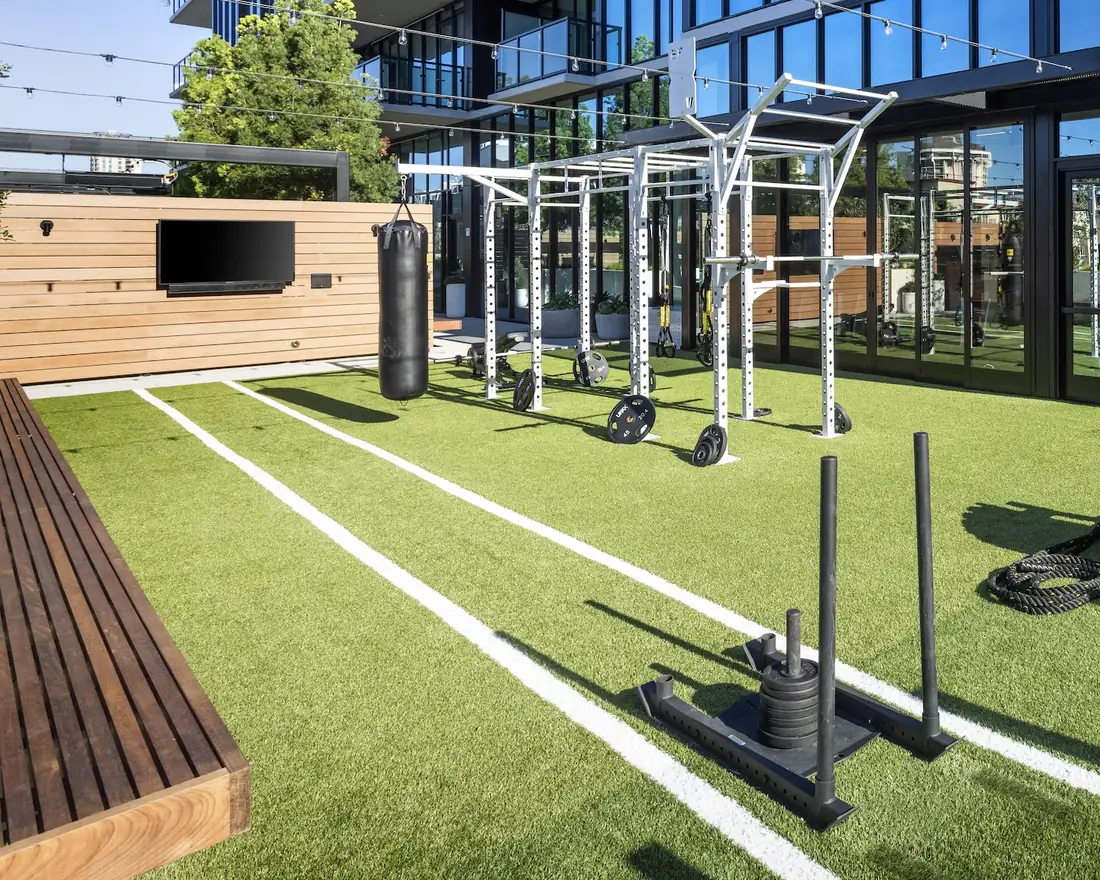
Delivery / Installation
Fit Supply delivers and installs commercial fitness equipment nationwide, coordinated through our network of installation partners; in Texas and Arizona, our own crews perform the work directly. Our team handles logistics, assembly and floor placement for a wide range of manufacturers, including Star Trac, StairMaster, Nautilus and FreeMotion.
More on delivery and installation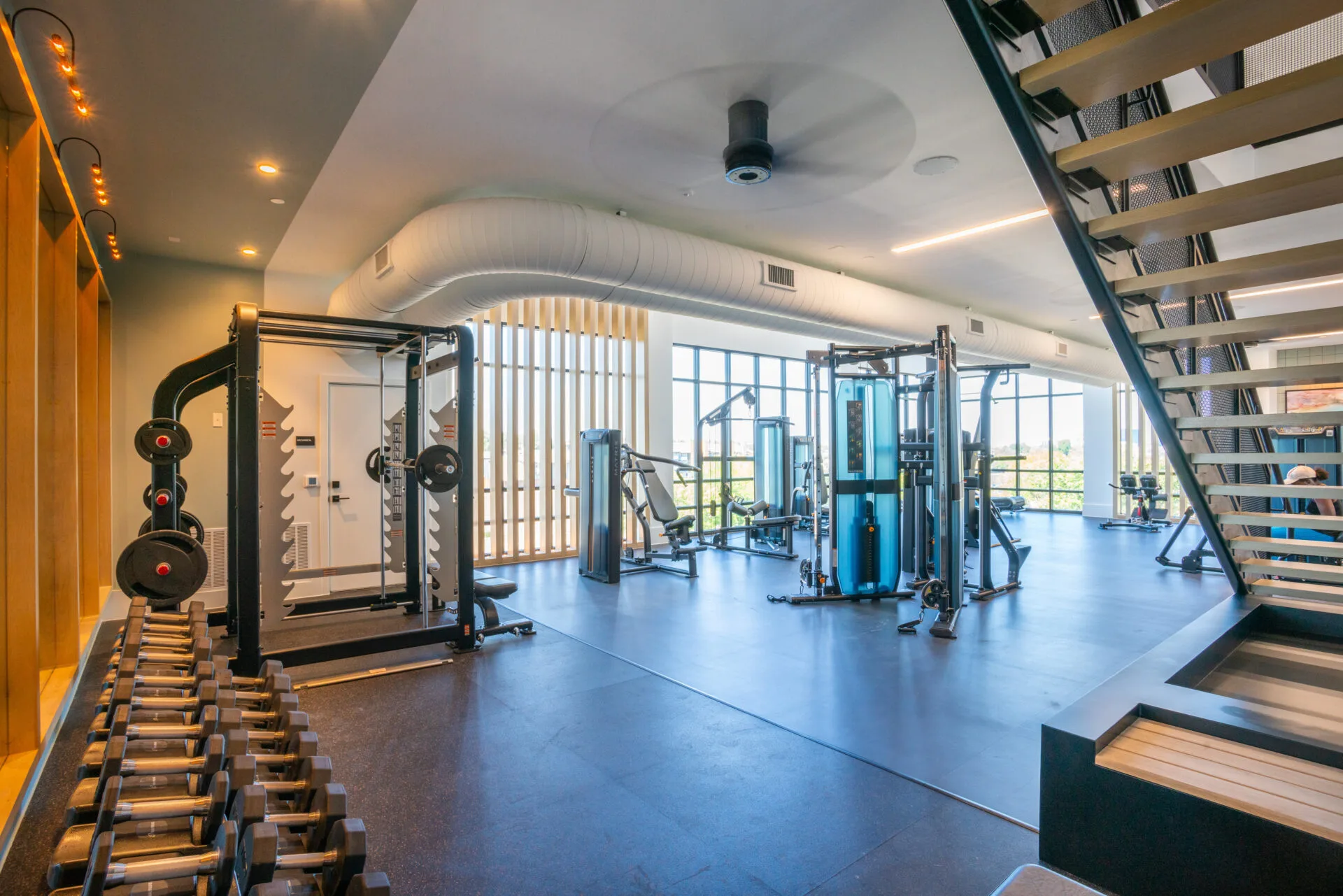
Service / Maintenance
Fit Supply provides preventive service, maintenance and repairs for commercial fitness equipment, scheduled against hours of use rather than the calendar. A plan is quoted from an asset register — make, model and serial number per unit — which decides whether the right part arrives the first time.
More on service and maintenance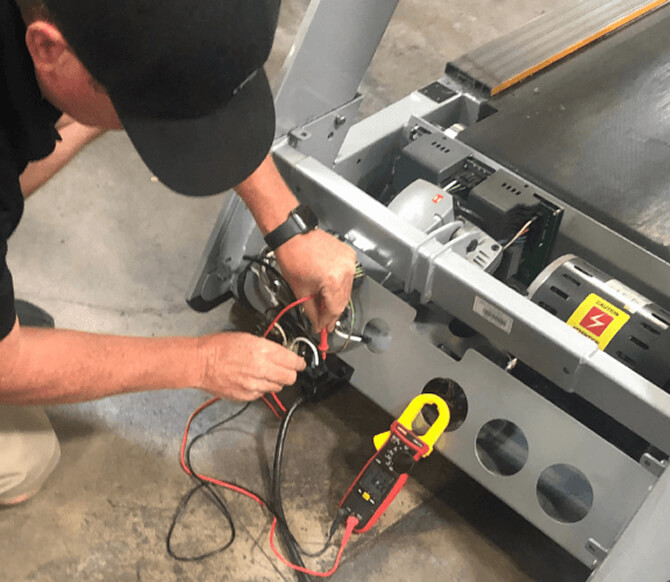
Extended Warranties
Fit Supply can extend coverage on commercial fitness equipment beyond the manufacturer term. Parts and labor are two separate coverage periods that frequently differ in length, and which one has expired is what decides who pays for a later repair.
More on extended warranties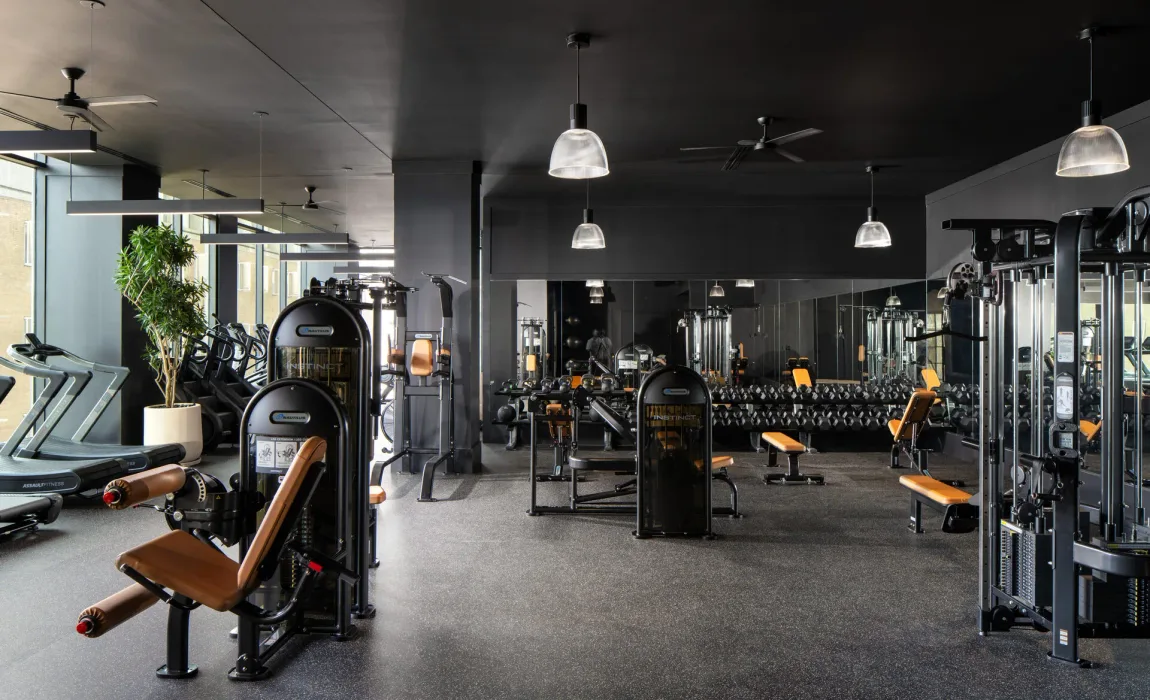
Finance Options
Fit Supply can structure a fitness equipment purchase as capital or as a periodic operating payment — two different budgets, with different approval paths and fiscal-year timing, which is often what decides whether a project happens this year.
More on finance options
Eleven services, two different footprints
Nationwide for Most of It, Hands-On in Two States
Equipment supply, design, flooring and procurement are nationwide with no geographic limit — four distribution centers and more than 30 installation partners reach all 50 states. On-site service and preventive maintenance are the exception, and the only one: Texas and Arizona, performed by our own technicians. Six metro hubs carry the detail for the markets we work in most.
- Dallas–Fort Worth Home market — the Irving office sits inside the metroplex. Design, installation and service pages
- Phoenix Run from Chandler, and the deepest service market Fit Supply has anywhere
- Houston One of the largest apartment markets in the country
- Tucson Second-deepest service history in the company, routed from Chandler
- Austin The fastest-building multifamily market in Texas
- San Antonio Weighted toward heavier free-weight and functional specification
Outside those six we publish a page for every market we cover — 83 in Texas and 41 in Arizona, plus installed work in all 50 states. The split is worth being plain about, because most of this industry is vague on it: we will supply, design and coordinate the installation of a facility anywhere in the country, and we will send our own technician to fix it in Texas and Arizona. Everywhere else, service runs through the partner network.
Questions about our services
Do you charge for gym layout and design?
It depends on the project, and it is confirmed in your quote rather than assumed. Fit Supply can consult on a design, produce the design itself, or do both — and where the equipment is purchased through us, design is frequently included. Ask when you request the quote and we will tell you exactly what applies to your project before you commit to anything.
What makes a Fit Supply layout different from a floor plan?
Our sales representatives are specialists in fitness facility design, not order takers, and a layout accounts for the things that make a room work or fail: safety and circulation, ADA access and clearances, electrical requirements and outlet placement, spacing between machines, and connectivity for networked equipment. A drawing that ignores power and ADA is a picture, not a plan.
What do you need from me to start a gym design?
Three things: the room dimensions, a budget range, and an idea of what you want the space to do. Dimensions are needed for any 2D or 3D CAD design — the same as any designer would ask for. The budget and the intent are what let us put the right equipment mix in front of you rather than a generic package.
How long does a gym design take?
Usually one to two weeks, delivered together with an equipment quote. You are not given a single take-it-or-leave-it option: we work through the space with you and typically present two to three quotes at different price tiers, with equipment choices at each, so you can see the trade-offs rather than just a total.
What are the lead times on commercial gym equipment?
Anywhere from in stock to roughly six months, depending entirely on what is ordered. Most cardio and most stock strength runs about two weeks. Accessories and HIIT products are typically one to two weeks. Custom strength is the long pole: custom colors, a different paint process or bespoke upholstery generally runs six to twelve weeks, and fully custom lines such as Atlantis, Gym80 or Panetta can reach six months. Lead time is the thing most likely to move your opening date, so it is worth settling early.
What are your payment terms?
Terms vary from deal to deal and are set out in your proposal. What does not vary: a 50% deposit is required on all orders before equipment is ordered. Finance options are available and are quoted alongside the equipment.
What warranty comes with the equipment?
Manufacturer warranties are passed through to you in full, and Fit Supply warrants its own installation work for 30 days. Warranty terms differ by manufacturer and by product line, so the specific coverage for what you are buying is set out in your quote rather than generalised here.
Is there a minimum order?
No. Fit Supply will sell a single set of dumbbells, one treadmill, or an entire facility. There is no minimum order value and no requirement to buy a package.
What does your installation include?
It starts with a site survey — we collect the measurements, access details and photographs before anything is quoted, so the install is priced against your actual building. Fit Supply installs essentially anywhere, including situations needing a crane or the temporary removal of railings, and that work is priced into the install rather than surfacing as a surprise. We also handle relocations, extractions, assembly and upholstery, and can provide storage for a fee.
How long does installation take?
It varies enough by job that a site survey is the only honest answer. What drives it is access rather than piece count: door widths, elevator availability, stairs, tight or turning hallways, and whether equipment can come in assembled or has to be taken apart and rebuilt in the room. Two identical equipment lists in two different buildings can be a day apart. We assess it on the survey and tell you before the schedule is set.
Are you insured, and can you install outside business hours?
Yes on both. Fit Supply is fully insured and can provide certificates of insurance for building management. We work to whatever schedule the site requires and have completed overnight and weekend installations where a facility could not close during the day.
Do you take trade-ins on old gym equipment?
Yes. Fit Supply will take equipment in trade and pay you for it where it has value. Where it has none, we can still extract and remove it for a fee, so a room can be cleared and re-equipped in one project rather than leaving disposal as your problem.
How long is a quote good for?
Thirty days from the proposal date, unless it is executed sooner. Prices exclude sales and use tax, freight, and similar charges, and tax is determined as of the taxable event — delivery or installation — rather than the quote date. Equipment lead times move independently of the quote validity, so a quote accepted on day 29 does not hold the manufacturer pricing or the schedule that existed on day one. If a decision is going to take longer than a month, tell us and we will re-quote rather than let it lapse.
Can I cancel or return equipment after I order it?
It depends what it is. Custom and modified products cannot be cancelled, returned, rescheduled or refused, and they require full payment up front. Standard stock products can be returned only with our prior written authorization, in new and resalable condition in the original packaging, at your expense and risk, and are subject to a 25% restocking charge. After a proposal is executed, cancellation carries a 25% fee of the proposal total. This is why we would rather spend the extra day on the layout than have you order twice.
What happens if equipment arrives damaged?
Inspect before you accept it and note any visible damage on the delivery receipt — that document is what a freight claim turns on, and a clean signed receipt makes concealed-damage claims considerably harder. Where we arranged the carrier, we file and pursue the claim with them on your behalf as an accommodation rather than handing you the freight company’s number. Where you arranged your own carrier or collected the equipment, the claim is yours to file directly with them.
What do I need to have ready before installation day?
A confirmed date, access, and a room that is actually finished. You are responsible for site readiness: adequate space, the flooring down, structural capacity for the equipment, and electrical service matching the proposal — as an example, 110V treadmills each need a dedicated 100–125VAC, 50/60Hz, 20A circuit on a NEMA 5-20R outlet, independently isolated. Electrical is the item most often discovered late and the most expensive to fix after the walls are closed, so it is worth confirming with your electrician against our equipment list well before the delivery date.
What if my space is not ready when the equipment arrives?
Tell us as early as you can and we will re-sequence rather than deliver into an unfinished room. Where product is held at your request more than ten days past the installation date, a storage fee applies; held beyond thirty days, a 25% restocking fee applies as well. Those are the contract terms, and they exist because held equipment occupies warehouse space and gets handled twice. A date moved a week ahead of time normally costs nothing; a truck turned away on the day does.
Are you responsible for damage to floors or doorways during delivery?
No, and this is worth planning around rather than discovering. Our terms exclude liability for damage to driveways, floors, walls, doorways, landscaping and other property along the delivery and installation path, including damage from delivery vehicles, which can weigh up to 12,000 lbs. You are asked to disclose conditions likely to cause damage before delivery. In practice the fix is cheap and boring: tell us about the soft driveway, the new lobby floor or the tight turn in advance, and we will protect it, use a smaller vehicle, or price curb-side delivery instead.
How do I know a payment or wire instruction from you is genuine?
Verify it by phone before sending anything, and use a number you already have. <strong>Fit Supply does not change its payment or wire instructions by email alone.</strong> If you receive any payment, wire or account instruction that appears to come from us — or any change to one — call a Fit Supply number taken from a prior invoice or our official records, never a number contained in the email itself. Email is an insecure channel, invoice-redirection fraud is common in this industry, and payment sent to the wrong account does not discharge what is owed.
Do you keep title to the equipment until it is paid for?
Yes. Title remains with Fit Supply until we are paid in full, and our terms grant a purchase-money security interest under the Uniform Commercial Code in the products and their proceeds. In normal circumstances no buyer ever encounters this — it exists so that unpaid equipment does not simply become someone else’s asset, and it is a standard protection for a supplier who orders equipment against a deposit. It does not affect your use of the equipment once the invoice is settled.
Are your 3D layouts and renderings stamped construction drawings?
No, and it matters that you know where the line is. Our space plans, layouts and 3D renderings are visualization and planning tools. They are not architectural or engineering services and must not be relied on for structural, electrical, code, accessibility or life-safety compliance. Where this site cites ADA clearances, IBC live loads or ASTM standards, that is to help you ask the right questions of the people who do carry that responsibility — your architect, engineer and, on a Texas project over the registration threshold, a Registered Accessibility Specialist.
What equipment brands do you carry?
Fit Supply carries a broad range of commercial equipment brands rather than any one house line. The mix on a project is matched to what that facility actually needs — budget, feature set and space — with particularly wide options in specialty categories like recovery. No manufacturer is favored over another; the room decides.
Why buy through Fit Supply rather than direct from a manufacturer?
Because a single manufacturer can only sell you what it makes. Fit Supply carries more brands than most dealers, including some of the strongest lines in the industry, and that breadth extends into recovery and flooring where the specialist options genuinely differ. That means the equipment mix is chosen around your facility rather than around one catalog — and it comes with the design, installation and service around it.
How much floor space do I need per piece of equipment?
Allow 25 to 50 square feet per station, the range ACSM publishes in its Health/Fitness Facility Standards and Guidelines. A treadmill or bike bank works near the lower end; selectorized strength sits around the middle; free-weight and functional zones need the upper end once bar path, bench pull-out and spotter access are counted. We size each zone against your actual equipment list rather than applying one average to the whole room.
What ADA clearances apply to a fitness room?
Under the 2010 ADA Standards, at least one of each type of exercise machine needs a 30-by-48-inch clear floor space connected to an accessible route — 36 by 48 inches where the space is enclosed on three sides. Accessible routes run 36 inches wide minimum, and a circular turning space is 60 inches. The clear floor space is allowed to overlap the accessible route and sit in the aisle behind a machine, which is often what makes a tight room work without losing stations.
Does my Texas project need a TAS review?
A commercial construction or renovation project in Texas with an estimated cost of $50,000 or more must be registered with the Texas Department of Licensing and Regulation and reviewed by a Registered Accessibility Specialist, with registration due within 30 days of submitting for permit. Projects under that threshold still have to meet the Texas Accessibility Standards; they just skip the formal state review. Confirm the current requirements with TDLR or your architect for your specific project.
Can you design around columns, low ceilings or an awkward room shape?
Yes — that is the normal case, particularly in a converted amenity space or a retrofit. Columns, soffits, sprinkler heads, door swings and ceiling height all constrain what can go where, and low headroom in particular rules out certain machines outright. We work from the room dimensions you supply, place the constraints first, and then match the equipment mix to what is left.
What governs where the cardio bank goes, before the equipment is even chosen?
Power. Commercial treadmill manufacturers specify a dedicated 120-volt, 20-amp branch circuit per unit, with a non-looped neutral and ground, and networked consoles need a data path on top of that. That requirement drives outlet placement, which drives console orientation, which drives the whole layout of the cardio bank — and electrical is the constraint most often discovered after the walls are already closed, which is the most expensive time to discover it.