

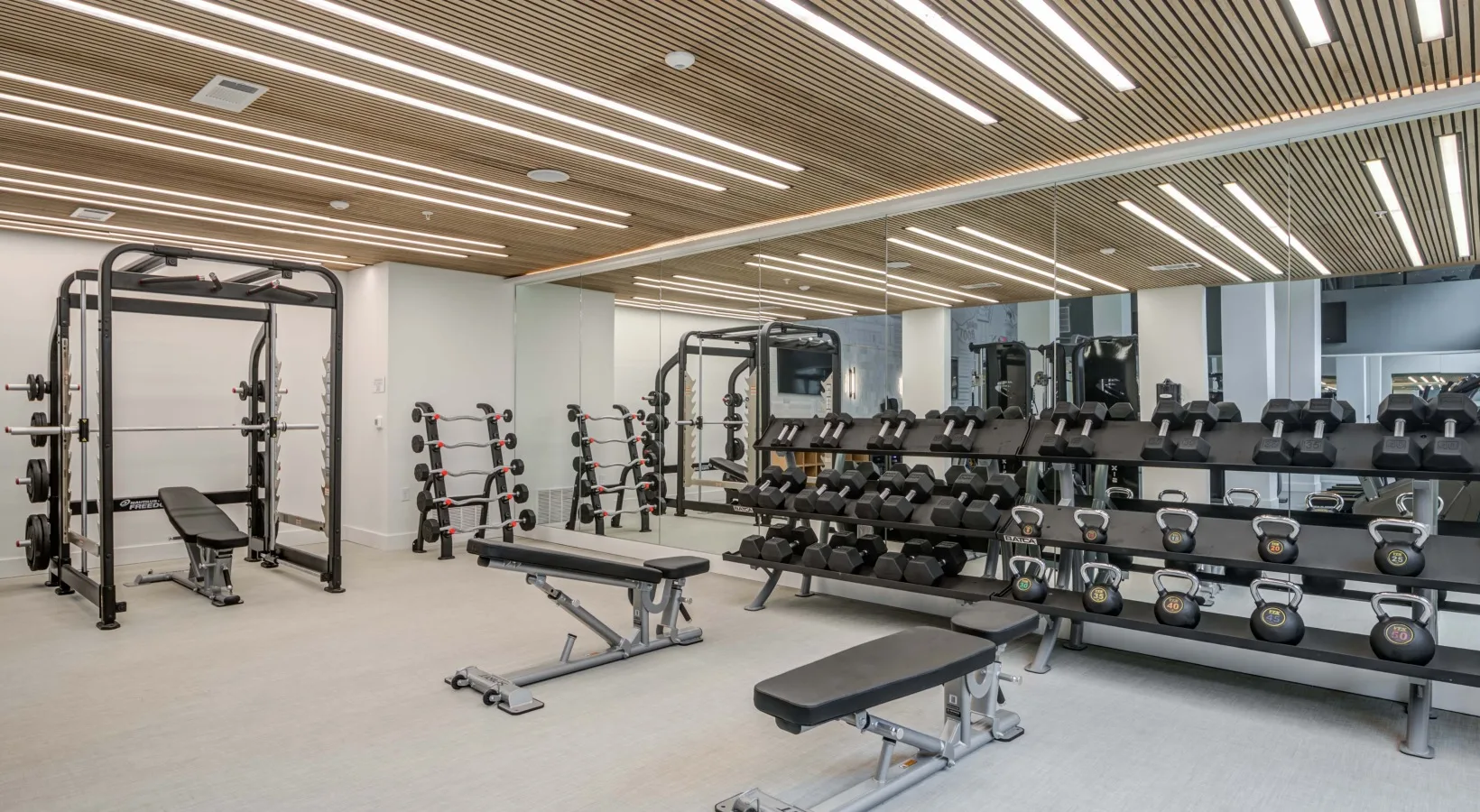
Flooring
Will the Gym Be Heard in the Apartment Below?
Why a Thicker Mat Is Not the Answer, and What Is
It is the complaint that arrives in month two, from the unit nobody thought about, and it is close to impossible to fix cheaply once the building is finished. It is also entirely predictable.
Two different noises, and they travel differently
Airborne noise — music, voices, a console — moves through the air and is stopped by mass and by sealing gaps. Impact noise is generated in the structure itself: a dropped dumbbell, a plate rack, someone running. It travels as vibration through the slab and radiates into the space below as sound, which is why a resident downstairs hears a drop they cannot possibly hear through a door.
Almost every fitness complaint is the second kind, and the second kind is not solved by anything that only adds mass on top.
The assembly is what performs, not the product
Three things contribute, and a specification that names only one of them is not a specification.
The structure
Slab thickness, span and construction set the baseline, and they are fixed by the time anyone is choosing flooring. This is the same conversation as the live-load question — IBC Table 1607.1 designs fitness areas for 100 psf against 40 psf for ordinary residential floor areas — and both are best asked of the engineer of record at the same time, because the answer decides where the room can go.
The floor build-up above it
Thickness, density and any acoustic underlayment all matter, and a drop zone is a different construction from a cardio bank. This is the part a supplier controls and the part most often asked to do all the work.
The ceiling below it
The assembly in the unit underneath — whether it is resiliently hung, what is in the cavity — is frequently the most effective place to intervene and is almost never mentioned in a flooring conversation, because it is not in the room anyone is looking at.
Acoustic performance is tested, not described
Adjectives are not data. Impact performance is measured on a specific assembly and reported, so ask for the test report for an assembly resembling yours — what was tested, in what construction, and by whom. A product that has been tested has a report; a product that has not has adjectives. Where a floor is being chosen for a multi-use or studio space, ASTM F2772 covers athletic performance properties of indoor sports floor systems — force reduction, vertical deformation, ball bounce, surface friction — as measured properties rather than claims, and the same principle applies: compare numbers from tests, not descriptions from brochures.
The cheap decisions that do most of the work
- Put the room where the problem is smallest. Over a garage, a lobby, a corridor or back-of-house rather than over a bedroom. This is a plan decision worth several times any flooring upgrade and costs nothing at schematic design.
- Decide whether anything gets dropped. A room specified without bumper plates and platforms generates a different problem from one with them, and that is a design decision rather than a restriction discovered later.
- Isolate the drop zone rather than the whole floor. Heavy build-up where impact happens, normal build-up everywhere else, with the transition specified.
- Ask the acoustic question in writing at design development, with the structural one, so the answers arrive while both are still cheap.
What each zone of the floor should be built up to is set out on our commercial fitness flooring page, and the zone-by-zone reasoning is in specify gym flooring by zone.
Published August 17, 2026 · 5 minutes read
More on commercial fitness flooring

Can Your Floor Take a Gym?
IBC Table 1607.1 designs fitness areas for 100 psf against 40 psf for ordinary residential floors. Why an upper-floor amenity gym is a structural question. Read the post.

Specify Gym Flooring by Zone, Not by Room
One thickness wall to wall overpays for the cardio half of a room and under-protects the half that takes impact. Specify by activity, and what ASTM F2772 measures. Read the post.

The Subfloor Decides the Floor
Concrete that has not dried will destroy an adhered floor. What ASTM F2170 and F1869 measure, when the tests happen, and why an uneven slab shows through rubber. Read the post.
In short
Usually yes, unless it is designed for. Impact noise from a fitness floor is a property of the whole assembly — the structure, the floor build-up on top of it and the ceiling below — and the flooring is only one of the three. A thicker mat helps and does not solve it, which is why the question belongs with the structural one at design development rather than at product selection — the same conversation as IBC Table 1607.1, which designs a fitness area for 100 psf against 40 psf for ordinary residential floor areas.
Part of what we do on commercial fitness flooring.


Common questions
Will thicker gym flooring stop noise reaching the apartment below?
It reduces impact noise and does not solve it. Performance belongs to the whole assembly — the structure, the floor build-up above it and the ceiling below — and flooring is one of the three. A specification that names only the mat thickness is not an acoustic specification.
What is the difference between airborne and impact noise in a gym?
Airborne noise — music, voices, consoles — travels through air and is reduced by mass and sealing. Impact noise is created in the structure by a dropped weight or running feet and travels as vibration through the slab, radiating as sound below. Nearly all fitness noise complaints are the second kind.
How do I compare two flooring products on acoustic performance?
Ask each for the test report on an assembly resembling yours — what was tested, in what construction, and by whom — and compare the reported numbers rather than the descriptions. A product that has been tested has a report. ASTM F2772 applies the same principle to athletic performance properties such as force reduction.
Where should a fitness room go to avoid noise complaints?
Over a garage, lobby, corridor or back-of-house area rather than over a bedroom. Location is a schematic-design decision that costs nothing and is worth several times any flooring upgrade, and it is the single most effective thing available before the structure is fixed.
Does allowing free weights change the noise problem?
Substantially. A room specified with bumper plates and platforms generates repeated high-energy impacts that a room of cardio and selectorized strength does not. Deciding deliberately whether anything gets dropped — and isolating the drop zone if it does — is a design decision rather than a restriction discovered after complaints.