

Case Study
A Buda Fire Station Gym Built for Job-Task Training
Two Stair Climbers, a TRX Training Zone and Free Weights to 100 lb for a Station That Trains on Every Shift
This is a real Fit Supply fire station gym in Buda, Texas, in the Austin area, told at full length: what the crews needed the room to do, and how the equipment list answers it.
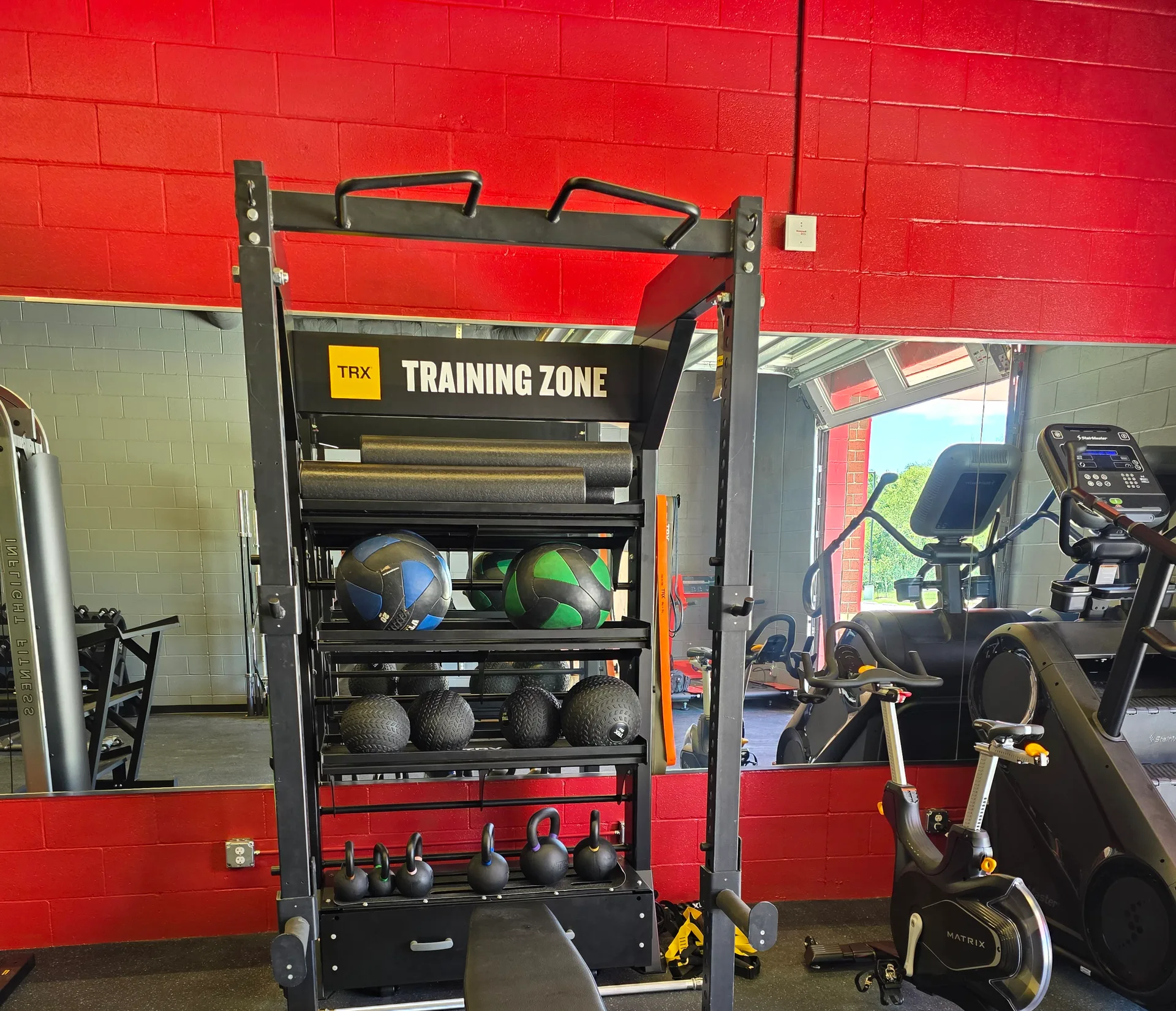
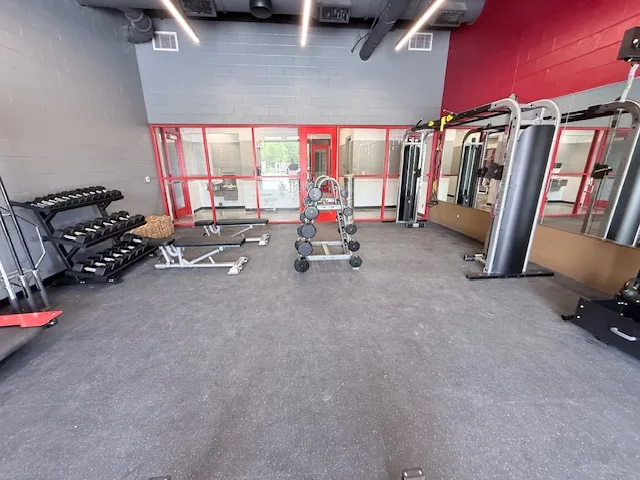
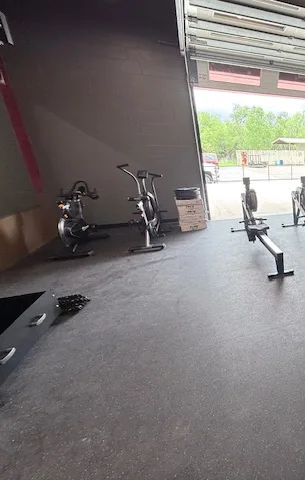
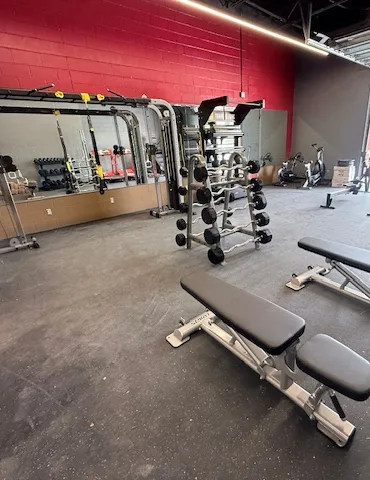
The photographs below are real install-day documentation — not a staged photoshoot. If a frame shows a stray tool, an unracked weight or a corner not yet tidied, that is what a real install day looks like, not a flaw in the finished room.
The Buda Station Gym
A station gym trains for a job, not for general fitness
Most of what a firefighter’s body does on a call is specific: climbing stairs in turnout gear with a hose pack, dragging and carrying dead weight, pulling and lifting from awkward positions, and doing it at a heart rate an ordinary gym session rarely reaches. A station gym earns its floor space by training those movements. A long row of machines that each isolate one muscle is the thing that crowds them out.
That was the brief for this fire station in Buda, south of Austin. The gym is a single open training room with an overhead door at one end, used by every crew on every shift with nobody supervising it, so each piece had to survive rotating, unsupervised use and had to earn its place against that list of movements.
Two stair climbers, because the stairs are the test
The cardio side is built around two StairMaster 8 Series Gauntlet stair climbers — revolving-staircase machines rather than steppers, so the user lifts their own body weight up a real step for as long as the session lasts. The stairs are where many careers start: the first of the eight events in the Candidate Physical Ability Test that many departments hire against is a three-minute stair climb at 60 steps a minute, wearing 75 lb to simulate gear and a high-rise pack. Two machines rather than one means a crew can train it together instead of queueing for the piece that matters most.
Around them sit two Concept2 RowErgs, an air bike and a Matrix indoor cycle for short, hard intervals, and a Spirit elliptical for low-impact days. Rowing and air-bike intervals build the repeat-effort capacity a long fireground demands, and both machines are simple enough that nothing needs explaining at three in the morning.
A suspension and strength zone instead of a row of single-purpose machines
The strength side is built around range rather than piece count. A TRX anchored suspension bay with the strength-bay add-on, a landmine attachment and wall shelving holds slam balls, kettlebells, a conditioning rope, strength bands and foam rollers in one zone a few feet deep — the drag, carry, rotate and throw work that job-task programs are written around. An Inflight cable crossover with a multi-function crossbeam and two 150 lb stacks covers pulling, pressing and single-arm work from any height.
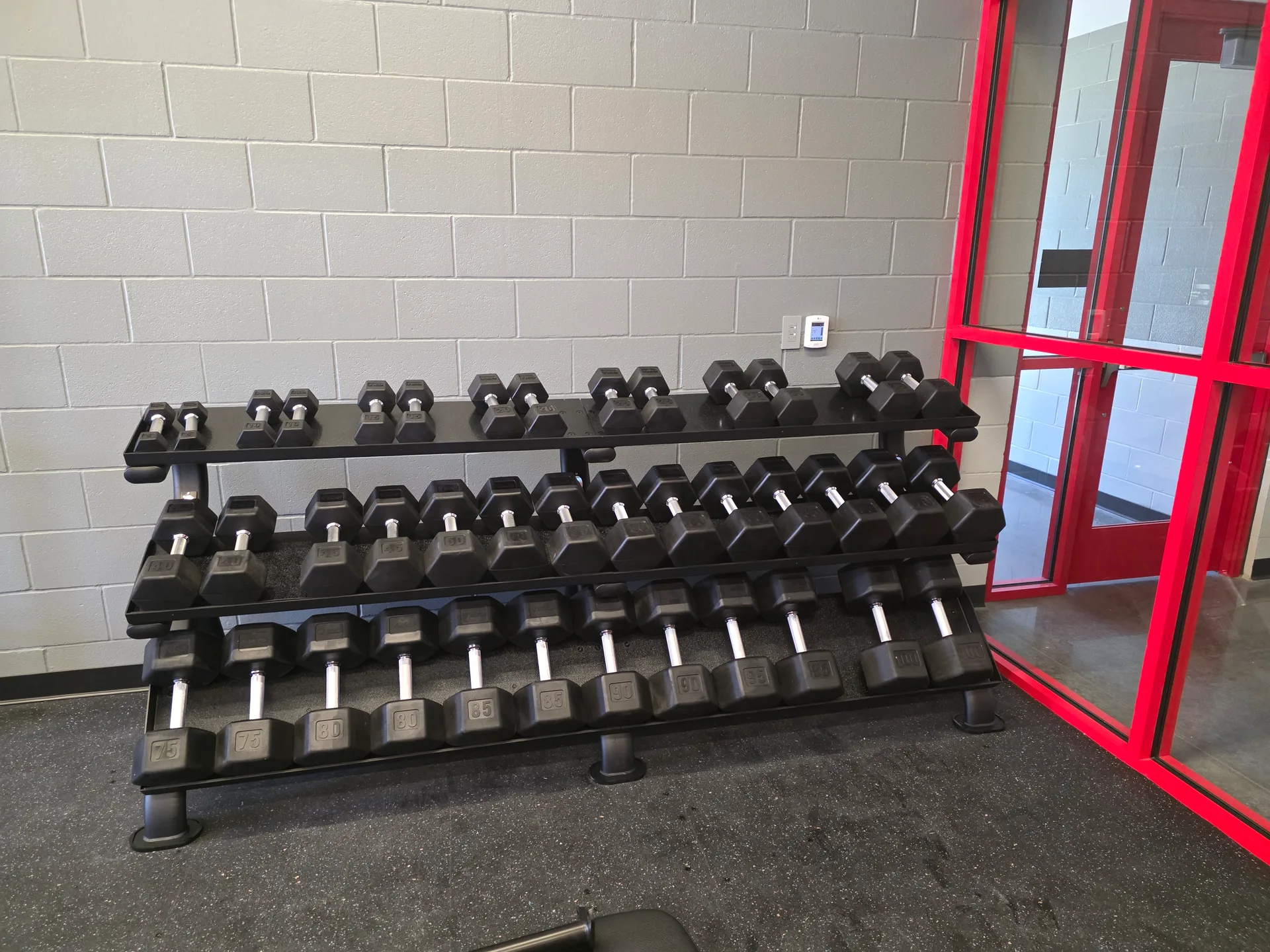
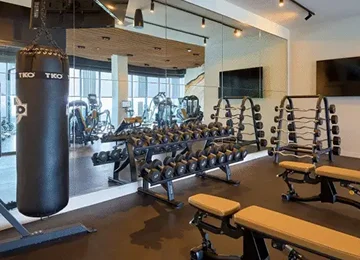
Free weights carry the rest: TKO rubber hex dumbbells from 5 to 100 lb across two racks, a Troy fixed curl-bar set from 20 to 110 lb, Body-Solid Olympic bars and rubber bumper plates, and two Spirit flat-incline benches. A Troy hex bar with raised handles is a deliberate choice for a station: it trains the lift a firefighter actually performs — picking a heavy, awkward load up off the floor — with a more upright back than a straight bar allows.
Flooring specified with the equipment, not after it
The whole room sits on 8 mm rubber flooring with a color fleck, glued down and installed as part of the same project. Specifying the floor alongside the equipment keeps two decisions consistent that are often made by different people: where the heavy dumbbells and slam balls will land, and what is underneath them. It also leaves one company answerable for the floor and everything standing on it. Our gym flooring page covers how a floor is specified by zone.
Bought early, held until the building was ready
The equipment for this room was specified and ordered years before it was installed, and held in storage until the room could take it. That is common on public-safety projects, where the equipment is funded in one budget cycle and the building finishes in another, and it is where a supplier either keeps a project intact or lets it come apart: the order placed while the money was there, the equipment stored rather than left on a construction site, and the installation booked once the room was finished.
When it was, delivery, assembly, flooring and placement were completed as one installation by the same team. That is the delivery and installation process every Fit Supply project runs, and before a room like this is ordered it is drawn — fitness facility design and layout covers how.
What a smaller station can take from it
Not every station has an open room with an overhead door. The same priorities scale down to a single bay or an upstairs room: a stair climber before a second treadmill, a suspension anchor and a wall of conditioning tools before another selectorized machine, dumbbells heavy enough for the strongest member of the crew, and rubber specified for the free-weight zone. Where the room sits above living or sleeping quarters, floor loading and impact noise become the first two questions, which our fire, police and municipal page covers in detail.
What a room like this is specified against
A room like this is laid out to the ADA Standards before the equipment list is final: a 30 by 48 inch clear floor space at each machine and a 36 inch accessible route between rows, drawn on the plan rather than assumed on the day. The mix is sized to ACSM’s 25 to 50 square feet per station, and the structure is checked against IBC Table 1607.1 — 100 pounds per square foot for a fitness floor, where a residential floor is designed for 40. Treadmills run on a dedicated 120 volt, 20 amp circuit apiece, and those circuits are marked on the plan with the machines. Flooring is specified by zone under ASTM F2772 — heavier rubber where plates land, lighter under cardio, turf where sleds run — and installed before the equipment arrives; the same approach is described on our commercial gym flooring page.
In short
A fire station in Buda, Texas needed a gym its crews could train in for the job itself: stair climbing under load, dragging, carrying and short, hard conditioning. Fit Supply specified, stored and installed the room — two StairMaster stair climbers, Concept2 rowers and an air bike, an Inflight cable crossover, a TRX suspension and strength zone, dumbbells to 100 lb and 8 mm rubber flooring — for a building that was not ready when the equipment was bought.
Part of what we do on fitness facility design and layout.
Common questions about this project
Was this a real Fit Supply project or a reference example?
A real one: the equipment specification, storage, flooring and installation for a fire station gym in Buda, Texas, on a real billed order with a real installation date. The station is described by city and facility type rather than by name, which is how every client on this site is described unless they have chosen to be named.
What is the most important piece of equipment in a fire station gym?
For most stations, a stair climber. Climbing stairs under load is one of the hardest things a firefighter does and the first event of the CPAT hiring test — three minutes at 60 steps a minute wearing 75 lb — and a revolving-staircase machine trains it more directly than a treadmill or an elliptical. This room has two so a crew can train together. After that, a suspension or functional zone and dumbbells heavy enough for strong users cover most job-task programs.
Can a department buy equipment before the station is finished?
Yes. The equipment for this room was ordered years before the station was ready and held in storage until installation could be scheduled. Storage is arranged and quoted per project rather than offered as a standing term, so it is worth raising at the quote stage if a building’s completion date is uncertain.
Do you install the flooring as well as the equipment?
On this project, yes — the 8 mm rubber was supplied and glued down as part of the same job. Flooring is specified by zone, with thicker rubber or platforms under free weights and lighter surfaces under cardio; see our gym flooring page.
Who services the equipment after installation?
In Texas and Arizona, our own technicians, on a preventive maintenance schedule or by service call; elsewhere service is coordinated through our partner network. A station gym is used by every crew on every shift, so a machine out of service is out for everyone until it is fixed — which is the argument for scheduled maintenance over waiting for a breakdown.