

Case Study
A Fort Worth Law Enforcement Gym for Group Conditioning
Fourteen Rowers, a Dual-Function Strength Line and a Treadmill Row Along the Windows
This is a real Fit Supply law enforcement fitness center in Fort Worth, Texas, where fire stations and police departments are much of what we equip.
The photographs below are real install-day documentation — not a staged photoshoot. If a frame shows a stray tool, an unracked weight or a corner not yet tidied, that is what a real install day looks like, not a flaw in the finished room.
The Fort Worth Fitness Center
One room, two very different users
A law enforcement fitness room serves two users who want opposite things from it. One is a group — a training class or a unit doing conditioning together — and for them the room has to put everyone on a machine at the same moment, or the session turns into a queue. The other is a single officer at the end of a shift, who needs the room to work with nobody else in it. Most rooms are specified for one of those and quietly fail the other.
This center in Fort Worth was specified for both. The cardio and conditioning side alone puts twenty-four people to work at once; the strength side is laid out so one person can train the whole body without waiting on, or needing, anyone else.
Fourteen rowers, because group conditioning is a scheduling problem
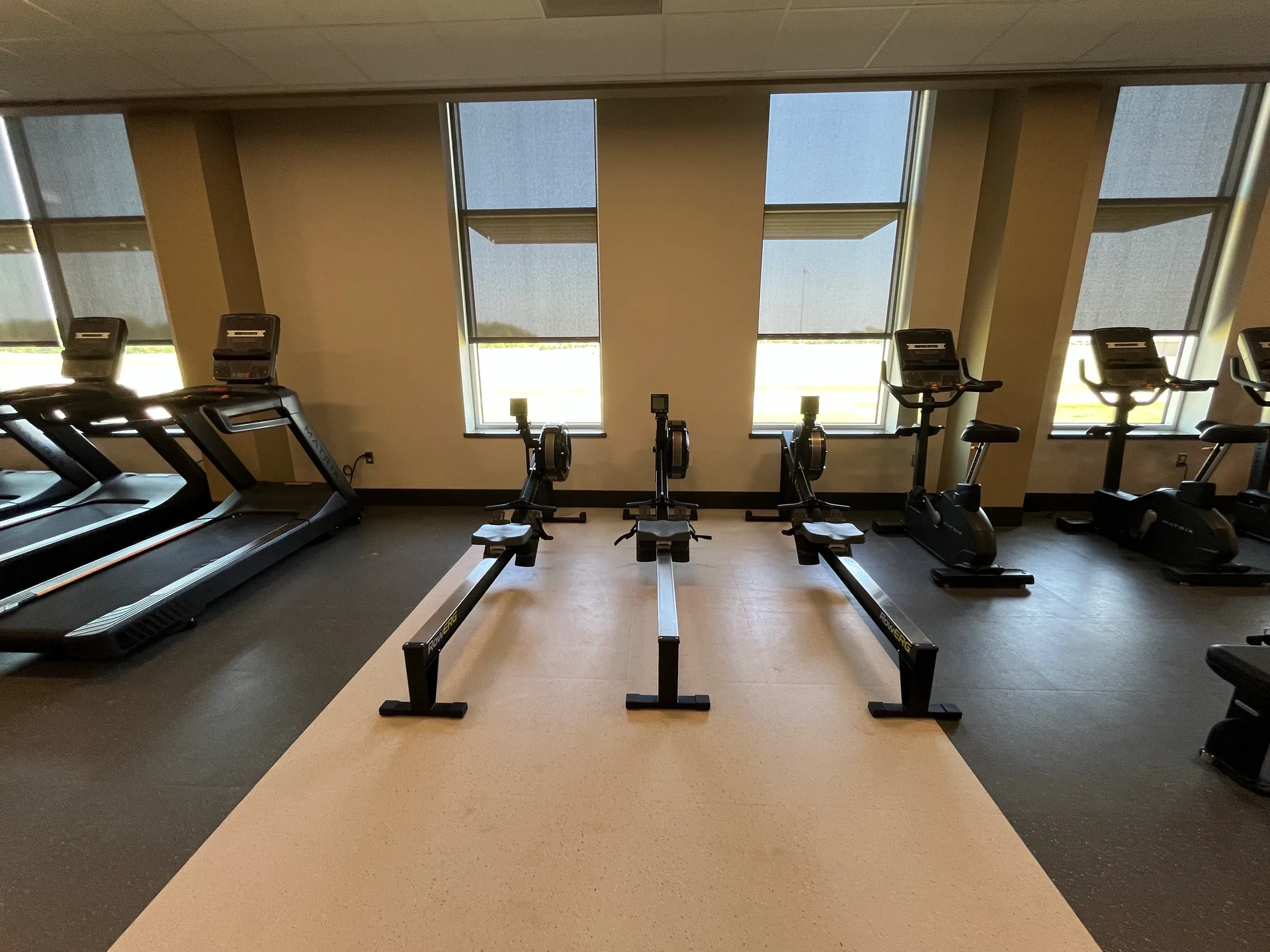
The centerpiece is a bank of fourteen Concept2 RowErgs, with three Matrix upright cycles and two air bikes alongside. Rowing is the conditioning tool that scales best to a group: it works legs, back and arms together, it is low-impact enough for an officer coming back from injury, and every machine reads out the same figures on its PM5 monitor, so an instructor can run one timed piece for the whole class instead of rotating people through stations.
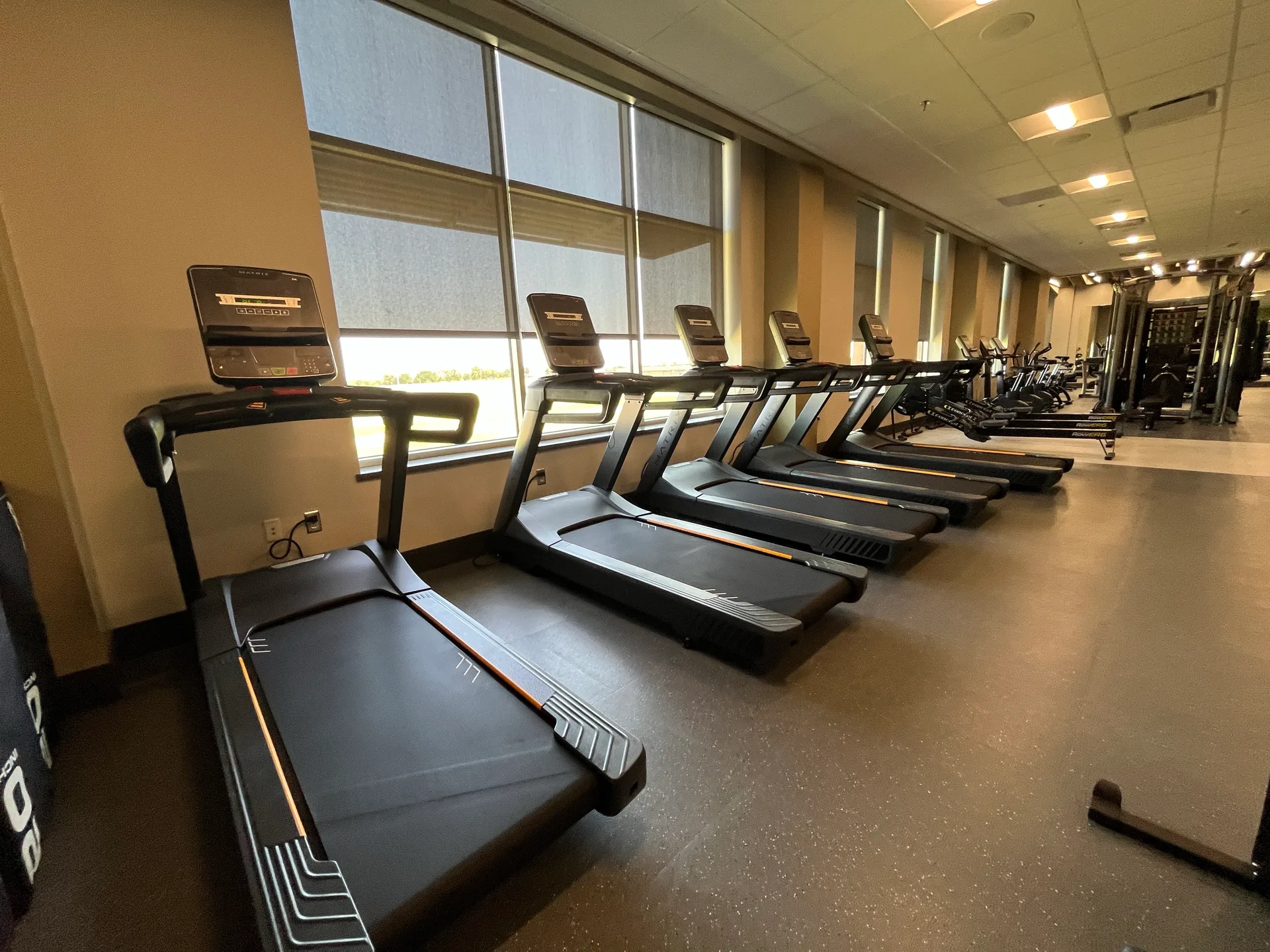
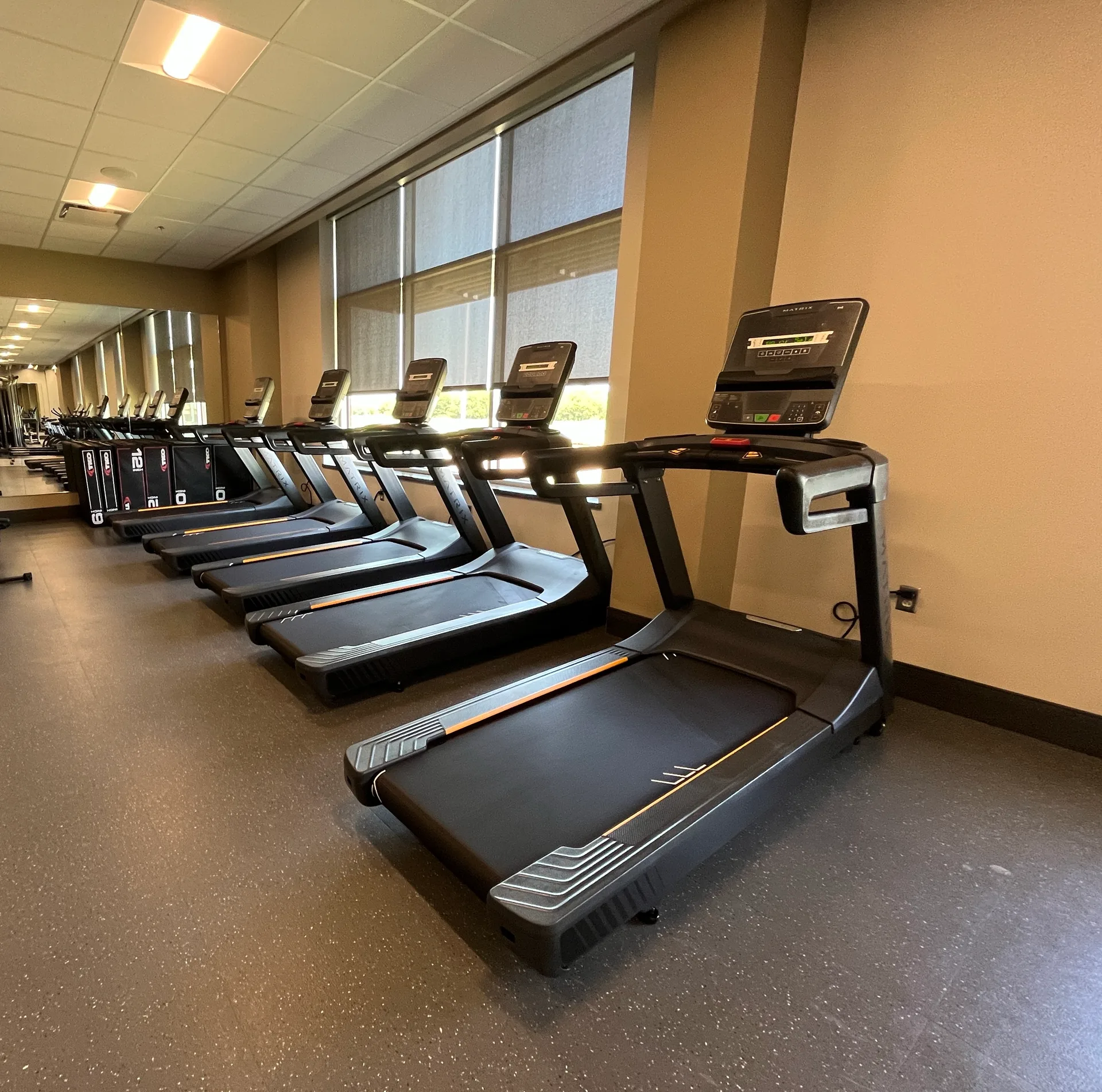
Five Matrix Endurance treadmills run along the window wall for the officer training alone, with daylight on one side and the rest of the floor on the other, so the room never reads as a corridor of machines facing a blank wall.
Fourteen strength movements in seven footprints
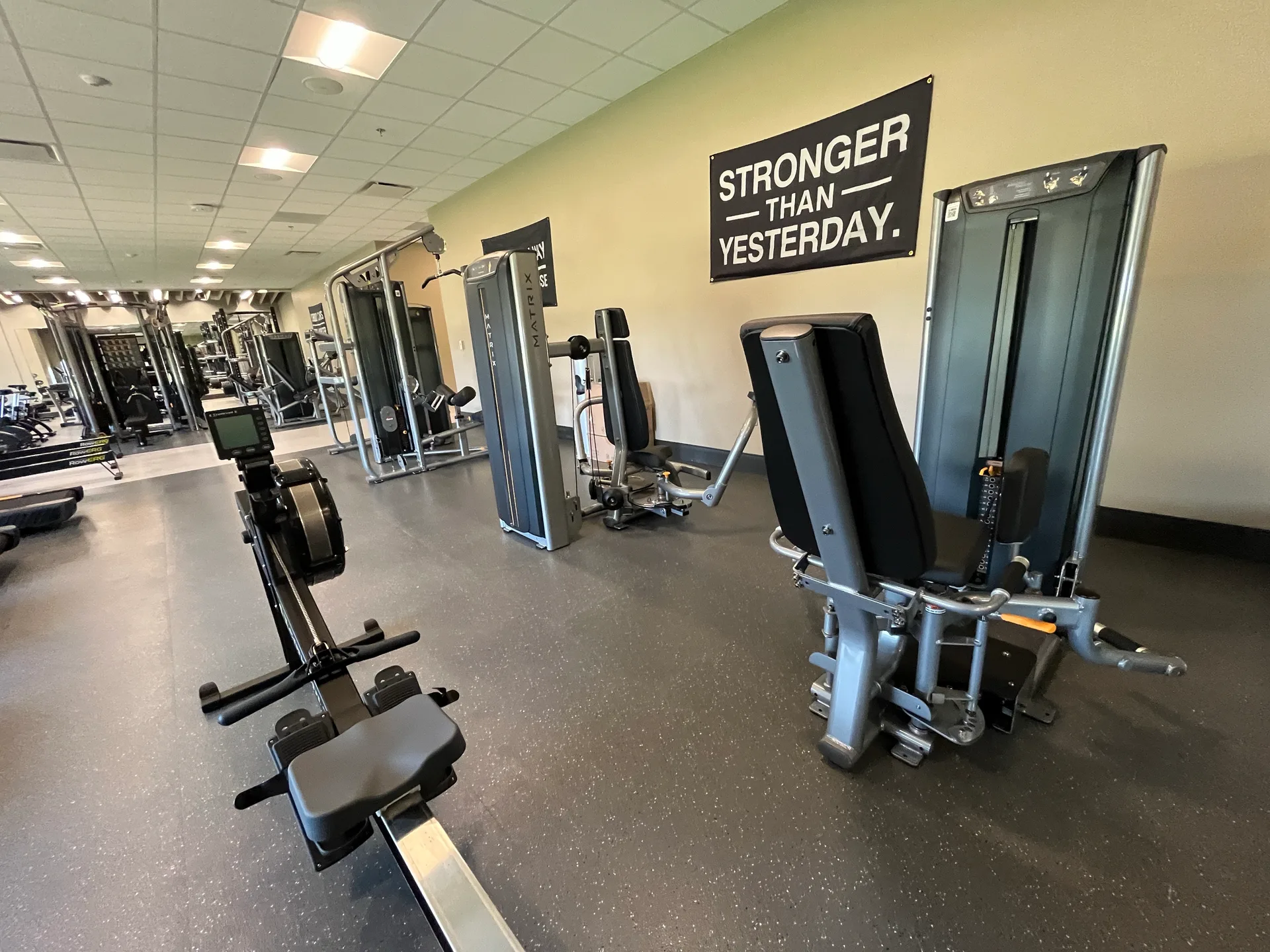
The selectorized line is Matrix Versa, and most of it is the Duals series — machines that each run two exercises on one weight stack: pec fly and rear delt, lat pulldown and row, leg extension and curl, triceps and biceps, low back and abdominal, hip adductor and abductor, and a multi-press, with a heavy-stack leg press beside them. Seven dual-function machines put fourteen movements on the floor in seven footprints, which is the difference between a full-body circuit fitting the room and not fitting it.
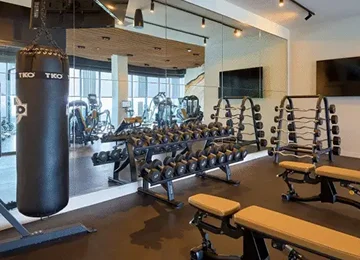
They suit a room like this for a second reason: an enclosed selectorized stack is the most forgiving way for someone training alone, without a spotter, to work hard. The free-weight side covers the users who want more — a Matrix Magnum combination power and half rack, a three-way Olympic bench, a Nautilus angled leg press, a preacher curl, adjustable and decline benches, TKO rubber hex dumbbells from 5 to 75 lb and a fixed-bar set to 110 lb — with a Matrix Aura functional trainer for cable work.
A floor organized so it stays organized
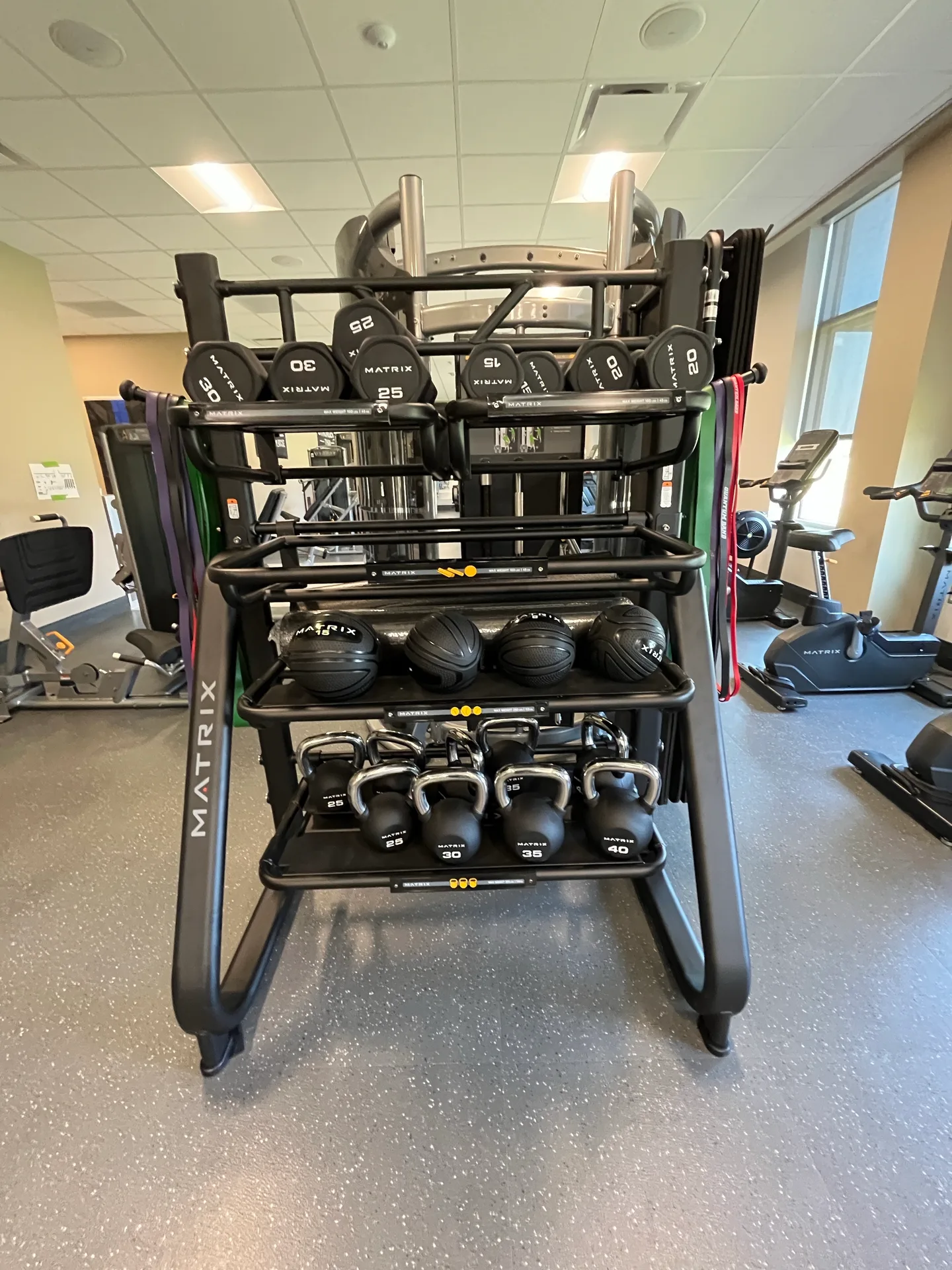
Group sessions leave accessories everywhere unless the room has a place for them. Here that is a Matrix Connexus storage station holding kettlebells, slam balls, bands and a balance trainer in one footprint, a studio dumbbell rack, a barbell rack and weight horns on the rack itself, and two cleaning stations so wipe-down happens at the machine. In a building shared across shifts, a room that is quick to reset is a room that is ready for the next one.
The old equipment moved, not scrapped
Alongside the new room, the project included removing existing fitness equipment and reinstalling it at another location, so it stayed in service rather than being thrown away. On a public building that step often decides the schedule: one space has to be cleared before the other is filled, and the people who use both are still on shift while it happens. Delivery and installation on a project like this includes that sequencing, not only the new equipment.
The same design and layout discipline applies at any size: the room measured, the group size it has to serve decided first, and the equipment count derived from that rather than from a catalog.
What a room like this is specified against
The layout is checked against the ADA Standards first — 30 by 48 inches of clear floor space at every station and a 36 inch route through the room — because moving a machine on paper costs nothing and moving it after delivery does. ACSM’s 25 to 50 square feet per station sets how much the room can hold; IBC Table 1607.1 sets what the floor can carry, 100 pounds per square foot for fitness use, and both are settled before the quote. Each treadmill is placed on its own dedicated 120 volt, 20 amp circuit, so the electrical drawing is part of the layout, not a note for the electrician afterwards. The surface is zoned to ASTM F2772 rather than laid as one sheet: thicker rubber under the strength floor, a thinner surface under cardio, turf for sled and agility lanes. Our flooring page covers the zoning in detail.
In short
A county law enforcement center in Fort Worth needed one room that could run a whole group’s conditioning session at once and still work for an officer training alone after a shift. Fit Supply supplied and installed it: a bank of fourteen Concept2 rowers, five Matrix treadmills along the window wall, a Matrix Versa dual-function strength line, a Magnum rack and free weights to 110 lb — and moved existing equipment out to be reinstalled at another location.
Part of what we do on fitness facility design and layout.
Common questions about this project
Was this a real Fit Supply project or a reference example?
A real one: the equipment supply and installation for a county law enforcement center’s fitness room in Fort Worth, Texas, on a real billed order with a real installation date. The agency is described by city and facility type rather than by name, as every client on this site is unless they have chosen to be named.
How many rowers does a group conditioning room need?
Enough for the largest group that trains together at one time, because the whole point is that nobody waits. This room has fourteen RowErgs plus three upright cycles and two air bikes, so a class of twenty-four can work at once. A smaller station or department can apply the same rule at its own size: count the biggest group first, then specify the machines.
Why choose dual-function strength machines?
Floor space. Each Matrix Versa Duals machine runs two exercises on one weight stack, so seven of them cover fourteen movements in seven footprints. In a room that also has to hold a rower bank and a treadmill row, that is what lets a full-body selectorized circuit fit at all.
Can you move existing equipment to another building as part of a project?
Yes. On this project, existing fitness equipment was removed and reinstalled at another location alongside the new installation. Removal, relocation and disposal are quoted per project, depending on what the equipment is worth keeping and where it is going.
Do you work with cities and counties on procurement?
Yes — formal quotes for bid processes, cooperative purchasing where an agency uses it, and documentation that survives a procurement review. Our fire, police and municipal page covers how public-safety rooms are specified and bought.